
Teamwork at the Trimming Chute

Reprinted with permission from Progressive Publishing
https://www.agproud.com/articles/62189-teamwork-at-the-trimming-chute
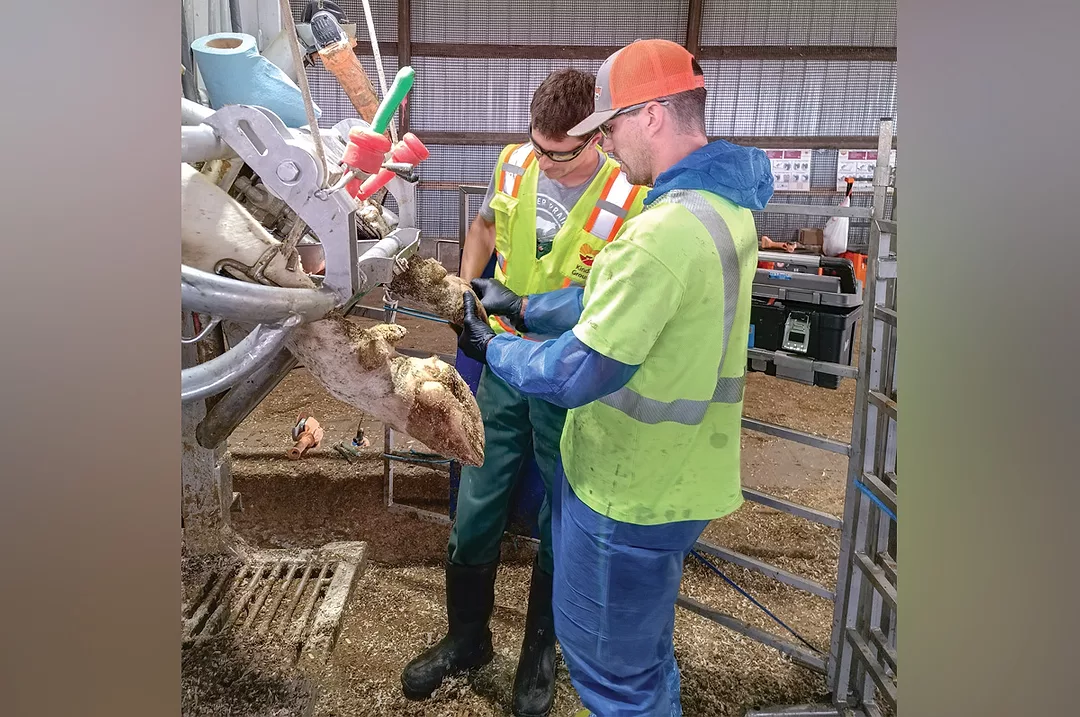
Teamwork at the trimming chute
October 20, 2025
A professional hoof trimmer and veterinarian share insights into having a more impactful, collaborative role in managing hoof health on dairies.
Managing hoof health takes a team effort. Following the most recent Kinder Ground’s Hoof Care Academy (KHCA) in Minnesota, the host dairy farm’s professional hoof trimmer, Willie Coyne with On The Money Hoof Care, and veterinarian, Dr. Alex Gander of Lester Prairie Veterinary Clinic, spoke of the importance of collaboration to manage hoof health on a dairy. Here are the big takeaways.

Co-Founder, Chief Animal Welfare Officer / Kinder Ground
Form a partnership
As one of the three partners covering seven counties in Minnesota, Gander wanted to raise the bar of the hoof care service he provided.
“I was lucky to have been trained on the basics during elective courses in veterinary school,” he said. “But like a lot of practices, I was lifting feet mostly in tiestalls over a beam. It’s quick, but it’s not safe. It’s not safe for me. It’s not safe for the people helping. It’s not safe for the cow.”
After KHCA 2025, Coyne helped Gander find a proper chute that he fitted to a trailer and is now trimming about every other day for clients with smaller herds. For his larger dairy clients, he trims and treats lame cows found in between regular visits by the hoof trimmer.
“By taking care of these small groups of lame cows in between maintenance trims, we can get the cow back on four legs and improve her quality of life and comfort,” Gander said. “I know the hoof trimmers are busy, so we are just trying to help where we can, really as more of a partner to the trimmers in the area.”
A partnership is exactly how Coyne sees it. With three full-time employees and two mobile chutes, his team keeps a full schedule, trimming up to 200 cows a day. That doesn’t allow much, if any, room for emergencies or urgent trims.
“For farms that don’t have someone in-house who can take care of cows when they come up lame in between hoof trimmer visits, it is important to have someone like [Gander] and his clinic available,” Coyne noted.
Keep track of trims
When a farm calls their vet clinic for hoof trims, it is important that the information is recorded and communicated to regular trimmers, like Coyne, so he can follow up with the cow. Keeping good records is essential. Coyne explained that there are a lot of tools out there, like Hoof Supervisor, that make it easy to record trim events and give detailed records of lesions and share them.
“If you have a hoof trimmer who doesn’t leave you a detailed record of the cows they did, what they did and what they found, it is impossible to make progress,” Coyne said. “That includes the veterinarian.”
The importance of routine trimming
While the availability for an emergency trim is important, both Coyne and Gander share frustration that some farms don’t have a regular hoof trimmer.
“Lameness touches every aspect of the dairy,” Gander said plainly. “If you don’t get your feet right, you don’t have a good set of legs. Your conception rates are going to suffer. Your transition period is going to suffer, which means more transition failures that will inhibit her through that next lactation. You’re even going to see more mastitis issues.”
Coyne agreed. “The farms that are investing in hoof health and doing better are going to stick around. You can’t take a shotgun approach. You have to work as a team because there is such an interplay between lameness and other issues.”
Gander shared that he has already seen progress on farms where his service has sparked conversations revealing opportunities for prevention, like using footbaths.
“Now I’m going out to farms to do groups, and I’ve noticed warts have decreased, but we’re also seeing a couple other issues,” he said. “Only now the farmer looks at me and asks, ‘What do I need to do?’”
Gander was quick to highlight the path to partnership by taking the time to reach out to the parties involved and explaining how much money is lost due to lameness. They are now working together to find ways to do better, including working on cow handling.
“The focus should be on prevention and finding lame cows early before they are too far gone,” Coyne said.
Build a collaborative team
Coyne said his partnership with Gander is rare among hoof trimmers, but appreciated. It’s a collaboration that supports all parties and the success of the dairy.
When it comes to building that team, Coyne explained that a good hoof trimmer looks at more than the chute.
“If you’re seeing problems, go walk through the barn,” he said. “Ask questions. If you do that, you’ll create clients who come to you when they have questions. They have to know you’re invested. I think when we start doing those things and if vets know we are trying and you make sure people know you want to be involved, you can add value.”
Gander agreed. “You have to build communication between your vets, your hoof trimmer, your nutritionist and your breeder, and make time for meetings between all those key players.”
Coyne emphasized that team meetings and communication is where leadership from management plays a key role in progress.
“Invest in leadership,” he said. “You have got to steer the ship; you have to recognize the value in having collaboration between your outside team members.”
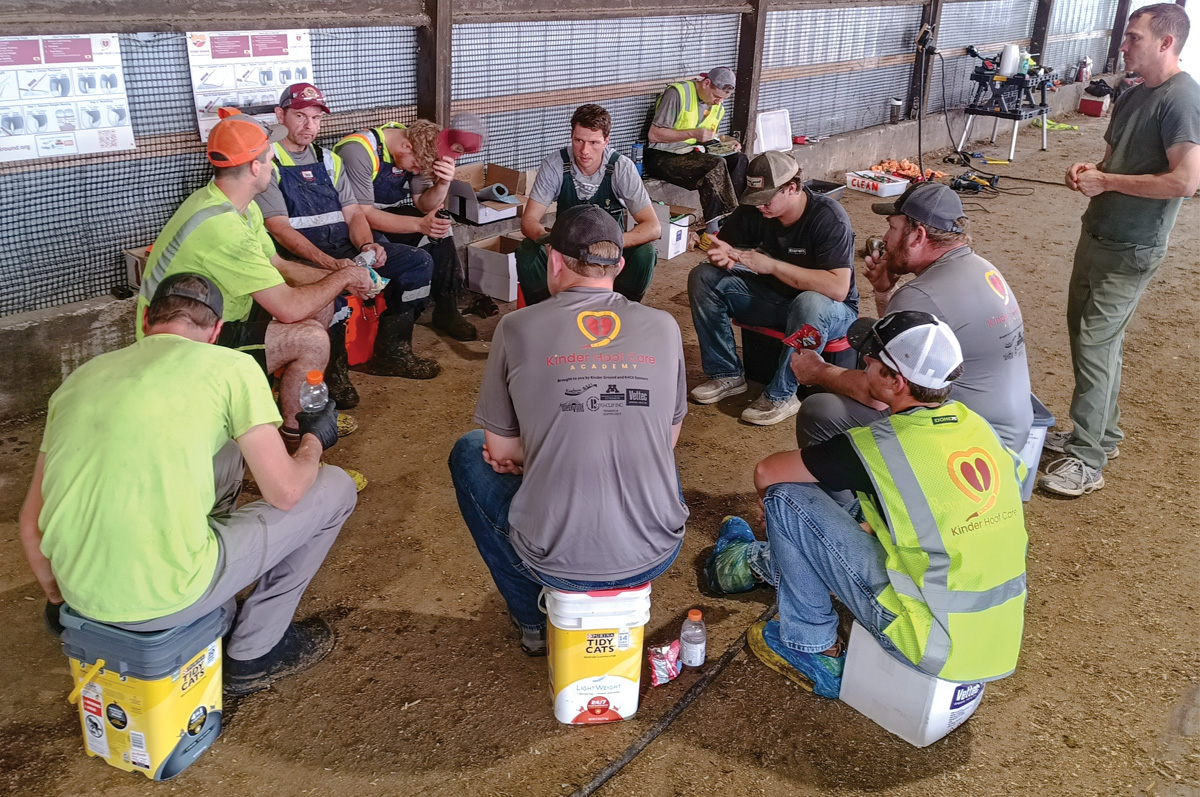
Participants of the Kinder Ground Hoof Care Academy discuss teamwork and collaboration on farms. Image courtesy of Kinder Ground.
Take the next steps
We wrapped up our discussion on what dairy farms could do to make their work at the chute more impactful.
“Detection is huge. Having a protocol, writing down cows, making it someone’s responsibility to look for lame cows,” Gander said. “If you can’t find them, you can’t fix them.”
Coyne agreed, saying, “When it’s everybody’s responsibility, it’s nobody’s responsibility.”
Indeed, while the welfare of the cows is everyone’s responsibility, making sure everyone knows their specific role and making sure someone is trained and dedicated to finding lame cows while they are still fixable is essential to making progress.
Who is responsible for finding lame cows on your farm? When was the last time you brought your herd health team together, including your hoof trimmer? Maybe now is a good time to consider both.